
Self-Employment Deductions Finder
Use our free self-employment deductions finder to discover every tax deduction you qualify for as a US freelancer. Enter your details and see how much you can save instantly.
How to use this self-employment deductions finder
Our self-employment deductions finder checks the most common tax deductions available to US freelancers and self-employed individuals in seconds.
Enter your annual gross income — your total freelance earnings before any deductions.
Enter your home office size in square feet if you work from home regularly.
Enter your business miles, health insurance premiums, retirement contributions, and other expenses.
Hit Find My Deductions to see your full deduction breakdown and estimated tax savings.
What are self-employment deductions?
Self-employment deductions are business expenses and personal costs that the IRS allows you to subtract from your gross income before calculating your tax bill. In other words, every dollar you deduct is a dollar the IRS cannot tax. Therefore, finding and claiming every deduction you qualify for is one of the most effective ways to reduce your quarterly tax payments.
Unlike W-2 employees who have limited deduction options, freelancers and self-employed individuals have access to a wide range of deductions specifically designed for business owners. As a result, many freelancers significantly underestimate how much they can legally deduct.
Why deductions matter for freelancers
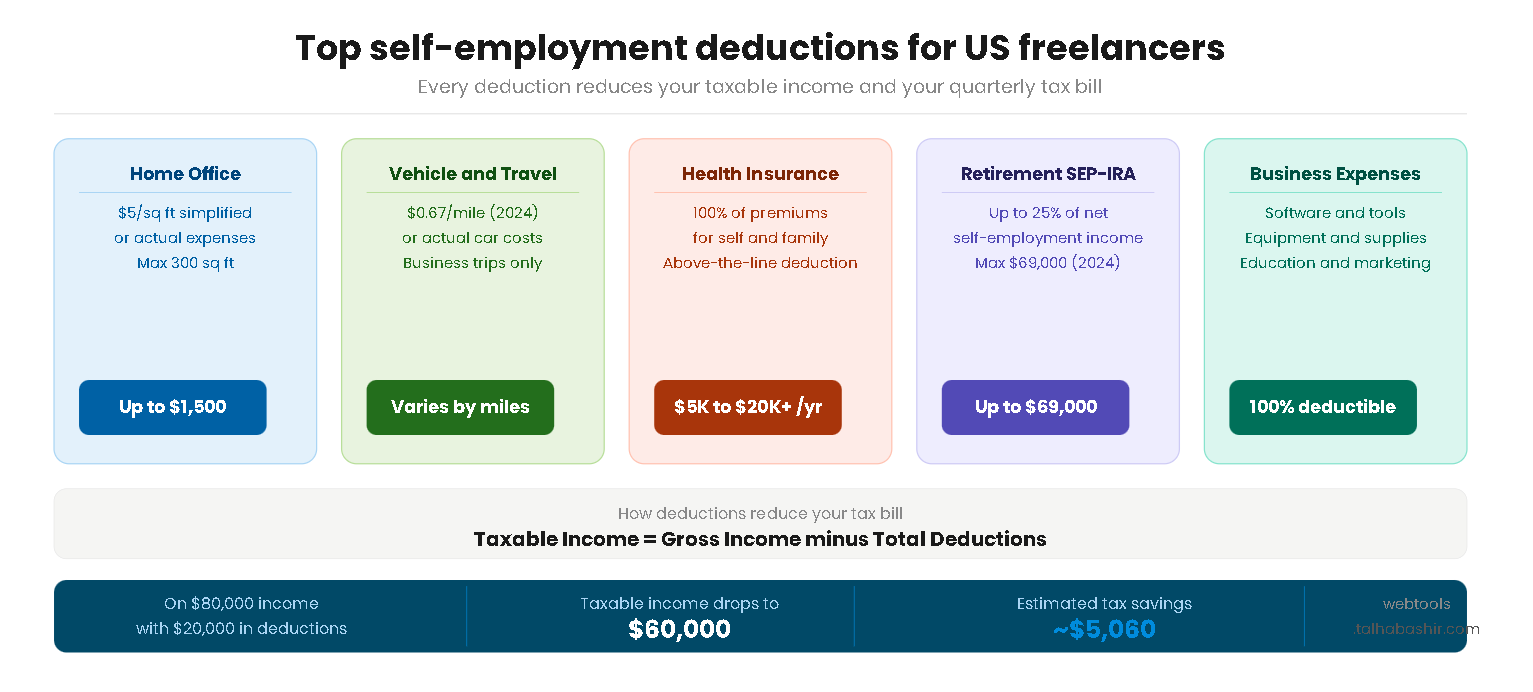
Consider this example — if you earn $80,000 and have $20,000 in legitimate self-employment deductions, your taxable income drops to $60,000. At a combined federal tax rate of around 25%, that is approximately $5,000 in tax savings. Furthermore, deductions reduce both your income tax and your self-employment tax simultaneously, compounding the savings even further.
Most freelancers only claim 3 to 5 deductions. The average self-employed person qualifies for 8 to 12. Use our self-employment deductions finder above to make sure you are not leaving money on the table.
Complete list of self-employment deductions
Here is a comprehensive breakdown of the most valuable self-employment deductions available to US freelancers in 2024. Each one directly reduces your taxable income and your quarterly estimated tax payments.
Home office deduction
If you use part of your home exclusively and regularly for business, you can deduct $5 per square foot up to 300 square feet using the simplified method — or deduct the actual proportional cost of rent, utilities, and mortgage interest.
Vehicle and mileage deduction
Business driving is fully deductible. You can use the IRS standard mileage rate of $0.67 per mile for 2024, or deduct actual vehicle expenses including gas, insurance, repairs, and depreciation based on business use percentage.
Health insurance premiums
Self-employed individuals can deduct 100% of health, dental, and vision insurance premiums for themselves and their family. This is an above-the-line deduction, meaning it reduces your adjusted gross income directly and does not require itemizing.
Retirement contributions
Contributions to a SEP-IRA, Solo 401(k), or SIMPLE IRA are fully deductible. A SEP-IRA allows you to contribute up to 25% of your net self-employment income with a 2024 maximum of $69,000 — making it one of the most powerful deductions available.
50% SE tax deduction
The IRS allows you to deduct 50% of your self-employment tax from your gross income before calculating your income tax. This deduction is automatic and applied by our self-employment deductions finder — you do not need to do anything special to claim it.
Business expenses
Any ordinary and necessary business expense is fully deductible. Common deductions include software subscriptions, equipment, office supplies, professional development courses, business insurance, accounting fees, marketing costs, and client meals at 50%.
How much can self-employment deductions save you?
The impact of self-employment deductions grows significantly with income. Here is a realistic example showing the tax savings for a freelancer earning $80,000 who claims common deductions:
| Deduction | Amount | Estimated tax saved |
|---|---|---|
| Home office (200 sq ft) | $1,000 | ~$250 |
| Vehicle mileage (5,000 miles) | $3,350 | ~$840 |
| Health insurance premiums | $6,000 | ~$1,500 |
| SEP-IRA contribution | $5,000 | ~$1,250 |
| 50% SE tax deduction | $5,652 | ~$1,413 |
| Software and business expenses | $3,000 | ~$750 |
| Total deductions and savings | $24,002 | ~$6,003 |
As this example shows, a freelancer earning $80,000 who actively claims their self-employment deductions could save over $6,000 in taxes per year — money that stays in their pocket rather than going to the IRS.
Tips to maximize your self-employment deductions
Knowing which self-employment deductions exist is only half the battle. Consequently, how well you document and track them determines how much you actually save at tax time.
Keep detailed records year-round
- Track every business expense — use accounting software like QuickBooks, FreshBooks, or even a simple spreadsheet to log every deductible expense as it occurs.
- Keep all receipts — the IRS requires documentation for deductions over $75. Store digital copies using an app like Expensify or simply photograph receipts immediately.
- Log business miles — maintain a mileage log with dates, destinations, and business purposes. Apps like MileIQ make this automatic.
Plan deductions strategically
- Maximize your retirement contribution — contributing to a SEP-IRA before the tax deadline is one of the most powerful last-minute deductions available to freelancers.
- Time equipment purchases — under Section 179, you can deduct the full cost of business equipment in the year of purchase rather than depreciating it over time.
- Work with a CPA — a good accountant who specializes in self-employed clients typically saves freelancers far more in taxes than their fee costs.
Learn more from the IRS directly:
IRS.gov — Self-Employed Individuals Tax Center IRS.gov — Home Office Deduction Guide