
Product Pricing Calculator
Use our free product pricing calculator to find the perfect selling price for any product. Calculate based on cost, target margin, platform fees, and competitor pricing — no sign-up required.
How to use this product pricing calculator
Our product pricing calculator gives you a data-driven selling price recommendation in seconds. Simply enter your costs and target margin and the calculator handles the rest.
Enter your cost price — what you pay per unit including manufacturing or wholesale cost.
Add shipping and platform fees — these reduce your actual margin and must be factored in.
Set your target profit margin — the percentage of the selling price you want to keep as profit.
Add a competitor price and monthly units to see your market position and total monthly profit.
What is a product pricing calculator?
A product pricing calculator helps business owners and e-commerce sellers determine the optimal selling price for their products. Rather than guessing or copying competitors, our product pricing calculator gives you a price based on your actual costs and desired profitability. As a result, you can make pricing decisions with confidence rather than intuition.
Pricing is one of the most important decisions in any product-based business. Set your price too low and you erode your margins — sometimes to the point where selling more actually loses you money. Set it too high and you lose customers to competitors. Therefore, using a structured approach to pricing is essential for long-term profitability.
Three proven pricing strategies
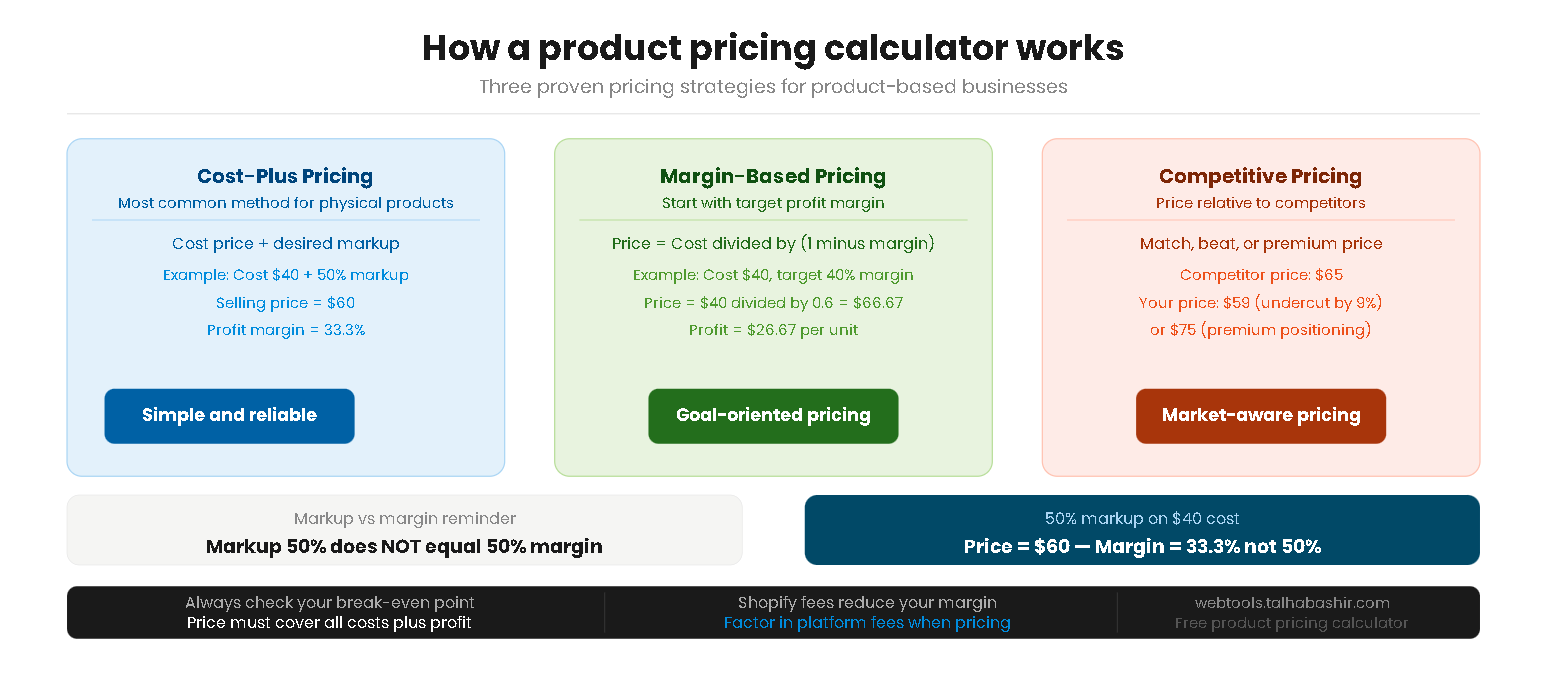
Cost-plus pricing
The simplest and most common method. Add up all your costs per unit — manufacturing, shipping, platform fees — then add a fixed markup percentage to arrive at your selling price. This guarantees a profit on every sale as long as your cost estimate is accurate.
Margin-based pricing
Start with your target profit margin percentage and work backwards to find the required selling price. For example, to achieve a 40% margin on a product that costs $30 all-in, the formula is $30 divided by 0.60, giving a selling price of $50. This approach ensures your pricing always meets your profitability goals.
Competitive pricing
Price your product relative to what competitors charge. You can undercut competitors to win on price, match them to compete on value, or price higher to position your product as premium. However, always verify that your chosen price still covers your costs and delivers the margin you need before competing on price alone.
Common product pricing mistakes to avoid
Most pricing errors come from incomplete cost calculations or misunderstanding the difference between markup and margin. Our product pricing calculator helps you avoid these, but understanding the underlying principles makes you a better business owner.
Forgetting platform and transaction fees
One of the most common mistakes is pricing based on cost alone without accounting for selling platform fees. Shopify charges 0.6% to 2.0% in transaction fees plus credit card processing fees of 2.4% to 2.9%. On a $50 product, this can amount to $1.50 to $2.50 per sale — which directly reduces your actual margin. Consequently, always include platform fees in your product pricing calculator inputs to see your true profit.
Confusing markup with margin
A 50% markup does not equal a 50% profit margin. If your cost is $40 and you apply a 50% markup, your price is $60 — but your margin is only 33.3% ($20 profit divided by $60 selling price). This distinction matters significantly when setting pricing targets. Our product pricing calculator shows both metrics so you can verify you are hitting your actual margin goal.
Rule of thumb — for most e-commerce products, aim for a minimum 30% gross margin after all costs including shipping and platform fees. Below 30%, it becomes very difficult to profitably run paid advertising and still make money.
Underpricing to beat competitors
Competing purely on price is a race to the bottom. Furthermore, customers who buy primarily on price are the least loyal and most likely to leave for anyone slightly cheaper. Instead, use our product pricing calculator to find a price that delivers healthy margins, then compete on product quality, branding, packaging, or customer service.
Always calculate your break-even point before launching. Break-even = Total fixed monthly costs divided by profit per unit. If your fixed costs are $2,000 and you make $20 profit per unit, you need to sell 100 units per month just to break even.
Learn more from trusted business resources:
SBA.gov — Pricing Strategy for Small Businesses Shopify Blog — How to Price a Product