
Business Formation Checklist
Use our free business formation checklist to walk through every step required to legally form your LLC or corporation in any US state — from choosing a structure to opening your business bank account. No sign-up required.
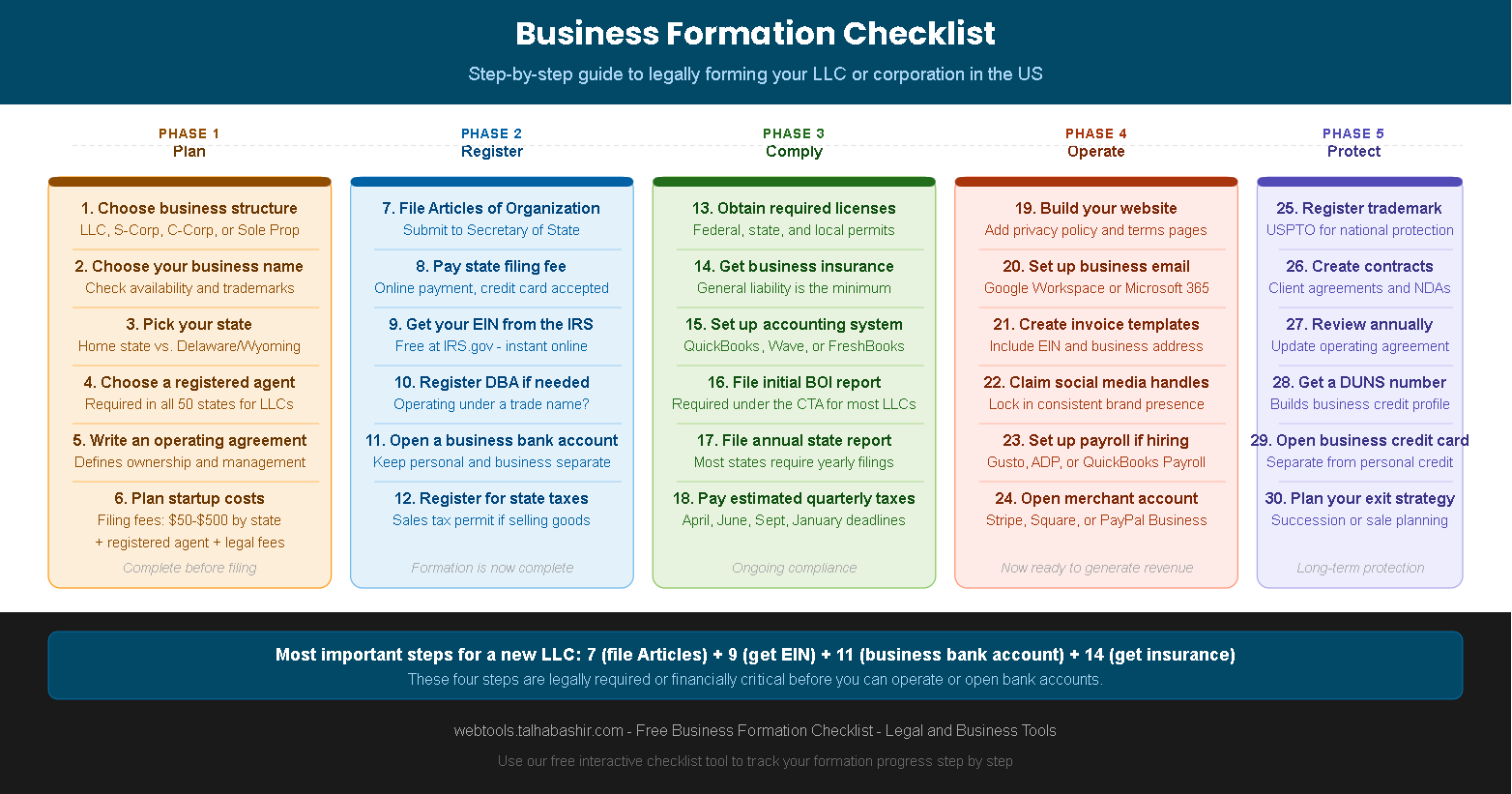
How to use this business formation checklist
This free business formation checklist generates a personalized step-by-step list based on your business structure and state. Every step is interactive — check items off as you complete them to track your progress through all five formation phases.
Select your business structure — LLC, S-Corp, C-Corp, sole proprietorship, or partnership.
Select the US state where you plan to register and operate your business.
Click Generate Checklist to see all required formation steps organized by phase.
Check off each step as you complete it and watch your formation progress bar fill up.
What is business formation and why does it matter?
Business formation is the legal process of establishing your business as a recognized entity under US law. Without completing the proper formation steps, you operate as an unregistered sole proprietorship by default — which means you have no liability protection, no formal business credit, and no separation between your personal and business assets.
Furthermore, improperly formed businesses often face problems when trying to open business bank accounts, apply for loans, sign commercial leases, or bring on partners. Therefore, following a complete business formation checklist from the start protects you legally and sets your business up for long-term success.
Which business structure is right for you?
The most important decision in your business formation checklist is choosing the right legal structure. Each structure has different implications for liability, taxation, and administrative requirements.
| Structure | Liability protection | Tax treatment | Best for |
|---|---|---|---|
| Sole Proprietorship | None — personal assets at risk | Pass-through (Schedule C) | Testing a new idea with minimal risk |
| LLC | Strong — personal assets protected | Flexible — pass-through or corporate | Most small businesses and freelancers |
| S-Corporation | Strong — same as LLC | Pass-through with payroll tax savings | Profitable small businesses with one owner |
| C-Corporation | Strongest — full separation | Corporate tax (double taxation risk) | Startups seeking investment, larger companies |
| Partnership | Varies — general partners at risk | Pass-through to each partner | Two or more co-founders starting together |
Most new US small businesses choose an LLC. It offers strong liability protection, flexible taxation, and minimal annual administrative requirements compared to a corporation.
How much does business formation cost in the US?
The total cost of forming a business in the US varies significantly depending on your state and structure. However, most entrepreneurs can complete their LLC formation for $100–$800, including all required fees. Below is a breakdown of the typical costs you will encounter in your business formation checklist.
State filing fee
Paid to your state's Secretary of State when filing Articles of Organization. Kentucky charges $40 while Massachusetts charges $500.
Registered agent
You can serve as your own registered agent for free, or use a professional service for $50–$300 per year for privacy and convenience.
EIN from IRS
Your Employer Identification Number is completely free directly from IRS.gov. Never pay a third party to obtain your EIN — it takes 5 minutes online.
Operating agreement
Single-member LLCs can use a free template. Multi-member LLCs benefit from having an attorney draft a custom agreement ($300–$500).
Business licenses
Many businesses do not require special licenses beyond a general business license. Industry-specific licenses (food, healthcare, construction) cost more.
Annual state report
Most states require an annual report with a small filing fee to keep your LLC in good standing. Fees typically range from $20 to $300 per year.
Never pay for your EIN. The IRS issues EINs for free at IRS.gov in minutes. Third-party services that charge $50–$100 for an EIN are not necessary and are a common scam targeting new business owners.
Official government resources:
SBA.gov — Register your business step by step IRS.gov — Apply for an EIN online for free