Privacy Policy Generator 2026 — Free for Any Website or App
Use our free privacy policy generator to create a ready-to-publish 2026 privacy policy for your website, blog, or app in seconds — covering Google AdSense requirements, CCPA, GDPR, and all standard US disclosures — covering CCPA, GDPR, Google AdSense, and standard US requirements. No sign-up required.
FreeAlways free to use
InstantReady in seconds
CCPA + GDPRBoth laws covered
No sign-upNo account needed
Generate your free privacy policy
Your generated privacy policy
How to use this privacy policy generator
Our free privacy policy generator creates a customized, ready-to-publish policy for your website or app in under two minutes. Simply fill in your details, select what data your site collects, and click Generate — no legal knowledge required.
1
Enter your website name, URL, owner name, and contact email address.
2
Select your business state and the type of website or app you operate.
3
Select all the data types your site collects — analytics, ads, forms, payments, and more.
4
Click Generate, then copy the policy and paste it into a new page on your website.
Why every website needs a privacy policy in 2026 — including for Google AdSense
A privacy policy is not optional for most websites in the US — it is a legal requirement under multiple federal and state laws, and a mandatory condition for using services like Google Analytics, Google AdSense, and most email marketing platforms. Without a published privacy policy, you risk account suspension, fines, and legal liability.
Furthermore, a well-written privacy policy builds trust with your visitors. Users are increasingly aware of their data rights, and displaying a clear, accessible privacy policy signals that your website is legitimate and transparent. Our privacy policy generator covers all the key disclosures required by US and international regulations.
Privacy laws that affect US websites
California
CCPA — California Consumer Privacy Act
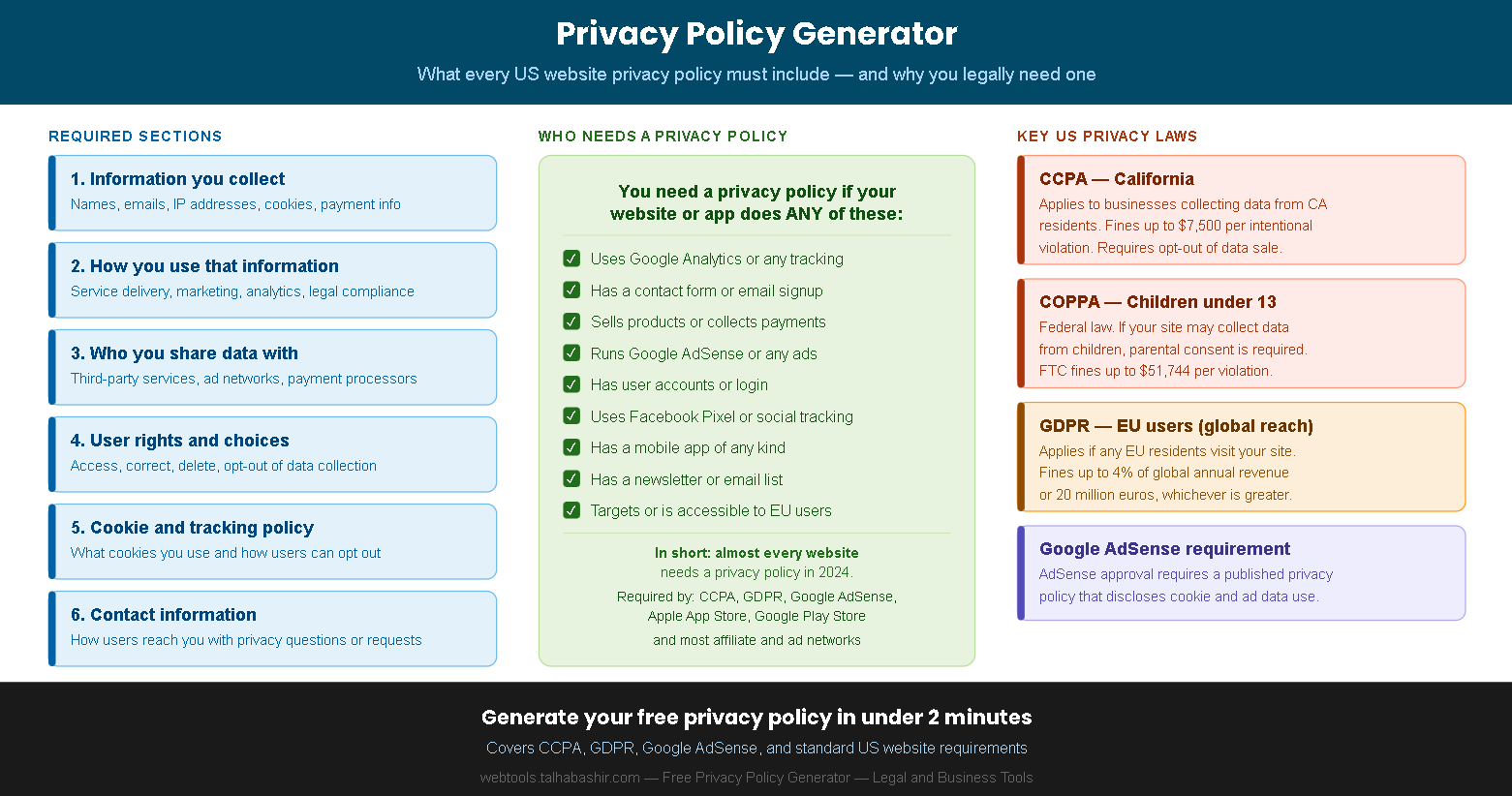
Applies to any business collecting personal data from California residents, regardless of where the business is located. Requires disclosing what data you collect, why you collect it, and giving users the right to opt out of data sales. Fines reach up to $7,500 per intentional violation.
Federal — Children
COPPA — Children's Online Privacy Protection Act
A federal law that applies if your website could collect data from children under 13. Requires verifiable parental consent before collecting any personal information. The FTC enforces COPPA with fines of up to $51,744 per violation — one of the highest penalties in US consumer law.
European Union
GDPR — General Data Protection Regulation
If any EU residents visit your website, GDPR applies — even if your business is based in the US. GDPR requires explicit consent for data collection, the right to be forgotten, and data portability. Fines reach up to 4% of global annual revenue or 20 million euros, whichever is higher.
Ad Networks
Google AdSense and ad network requirements
Google AdSense requires all publisher websites to display a privacy policy that clearly discloses the use of cookies and data collection for advertising purposes. Without a compliant privacy policy, your AdSense application will be rejected and existing accounts can be suspended.
If your website uses Google Analytics, you are legally required to disclose this in a privacy policy — even if you collect no other user data. Analytics tracking constitutes personal data collection under both CCPA and GDPR.
What a 2026 privacy policy must include for small business websites
Our privacy policy generator automatically includes all required sections based on your inputs. However, understanding what each section covers helps you verify that your policy is complete and accurate.
Required sections for US websites
Information collected — a clear list of every type of personal data your site collects, including names, emails, IP addresses, cookies, and payment information.
How information is used — an explanation of why you collect each type of data, such as to provide services, send marketing emails, or display personalized ads.
Third-party sharing — disclosure of every third party that receives or processes user data, including Google Analytics, payment processors, and email marketing platforms.
User rights — a description of users' rights to access, correct, delete, or opt out of data collection, as required by CCPA and GDPR.
Cookie policy — an explanation of what cookies your site uses, what they track, and how users can disable them.
Contact information — a clear way for users to reach you with privacy questions, data access requests, or deletion requests.
Policy effective date — the date the policy was last updated, which is required to demonstrate compliance over time.
Never copy another website's privacy policy and use it as your own. Doing so may expose you to liability for disclosures that do not match your actual data practices — and it violates copyright law.
Is a privacy policy legally required for my website?+
Yes — for most websites. If your site uses Google Analytics, has a contact form, collects email addresses, runs ads, or processes payments, you are legally required to publish a privacy policy under US and international law. California's CCPA applies to any business collecting data from California residents. GDPR applies if any EU users visit your site. Additionally, platforms like Google AdSense, MailChimp, and most affiliate networks require a published privacy policy as a condition of using their services.
Where should I put my privacy policy on my website?+
Your privacy policy should be easy to find from any page on your website. The most common placement is a link in your website's footer — labeled "Privacy Policy" — which appears on every page. Additionally, if you have a contact form, checkout page, or email signup form, you should include a direct link to your privacy policy on those pages. Google AdSense specifically requires that the privacy policy link be visible on every page that displays ads, which is why a footer link is the standard approach.
How often do I need to update my privacy policy?+
You should update your privacy policy any time your data practices change — for example, when you add a new analytics tool, start running ads, add a payment system, or integrate a new third-party service. Additionally, it is good practice to review your policy at least once a year to ensure it reflects your current practices. Always update the "last updated" date at the top of the policy whenever you make changes, and consider notifying existing users of significant updates via email.
Does my privacy policy need to cover Google Analytics?+
Yes — Google Analytics collects personal data including IP addresses, device information, and browsing behavior, which constitutes personal data collection under both CCPA and GDPR. Your privacy policy must disclose that you use Google Analytics, what data it collects, and how users can opt out. Google's own terms of service for Analytics require publishers to have and display a compliant privacy policy that includes this disclosure. Our privacy policy generator automatically includes this language when you select Google Analytics.
Can I use the privacy policy generated by this tool on a real website?+
Yes — the privacy policy generated by this free tool is written to cover the key legal requirements for US websites and is suitable for publishing on your site. However, this tool provides a general template based on your inputs and does not constitute legal advice. For businesses handling sensitive data, operating in highly regulated industries (healthcare, finance, children's services), or processing large volumes of personal data, we strongly recommend having an attorney review your privacy policy to ensure it fully meets your specific legal obligations.
What is the difference between a privacy policy and terms of service?+
A privacy policy explains how your website collects, uses, stores, and shares user data — it is primarily a disclosure document that satisfies legal requirements around data protection. Terms of service (also called terms and conditions) is a contract between you and your users that sets the rules for using your website, including intellectual property rights, acceptable use, disclaimers of liability, and dispute resolution. Both documents serve different purposes. Most websites that have users or sell anything need both, but a privacy policy is the more universally required of the two.
This privacy policy generator provides a general template for informational and educational purposes only. The generated policy is not a substitute for legal advice and may not cover all requirements specific to your industry, jurisdiction, or business model. Always consult a qualified attorney to ensure your privacy policy fully complies with applicable laws.