
Calorie Deficit Calculator
Use our free calorie deficit calculator to find exactly how many calories you need to eat daily to lose weight. Based on your age, weight, height, and activity level — no sign-up required.
How to use this calorie deficit calculator
Our calorie deficit calculator gives you a personalized daily calorie target in seconds. Simply enter your details and the calculator does the rest.
Select your gender and enter your age — both affect your base metabolic rate.
Enter your weight in pounds and height in inches for an accurate BMR calculation.
Select your activity level — be honest, as overestimating is the most common mistake.
Choose your weight loss goal and hit Calculate to see your daily calorie target.
What is a calorie deficit?
A calorie deficit occurs when you consume fewer calories than your body burns in a day. In other words, our calorie deficit calculator identifies the gap between what you eat and what your body needs — and that gap is what drives weight loss.
Your body requires a certain number of calories each day just to maintain its current weight. This is known as your Total Daily Energy Expenditure (TDEE). When you consistently eat below your TDEE, your body turns to stored fat for energy. As a result, you lose weight over time.
The 3,500 calorie rule
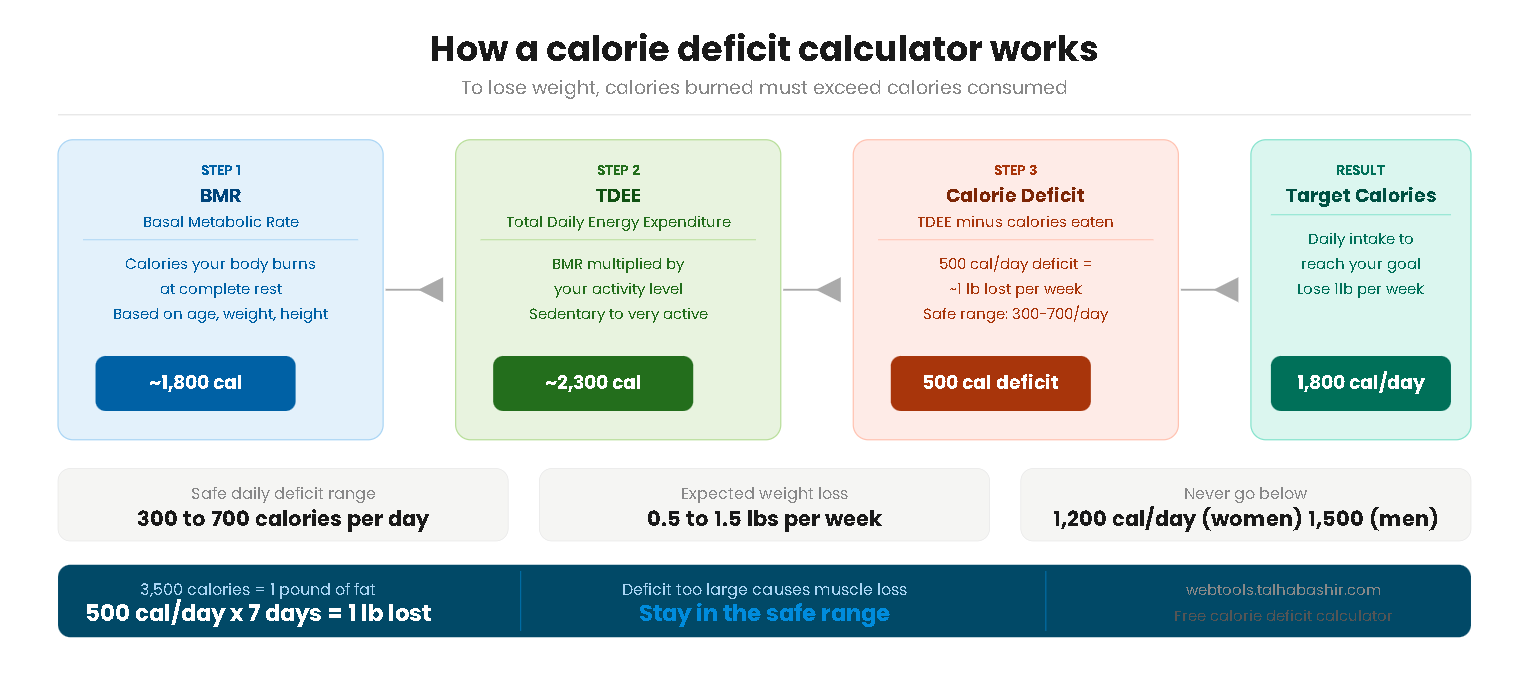
One pound of body fat contains approximately 3,500 calories. Therefore, to lose one pound per week, you need a daily calorie deficit of 500 calories (500 x 7 = 3,500). This is the most widely recommended rate of weight loss and is considered safe and sustainable by most health professionals.
Safe deficit range: 300 to 700 calories per day. Deficits larger than 1,000 calories per day can cause muscle loss, nutrient deficiencies, and metabolic slowdown — even if weight loss appears faster short-term.
How does the calorie deficit calculator work?
Our calorie deficit calculator uses the Mifflin-St Jeor equation — the most accurate BMR formula available for the general population according to the American Dietetic Association. Here is how it works step by step:
Step 1 — Calculate BMR
BMR is the number of calories your body burns at complete rest — just to keep your heart beating, lungs breathing, and organs functioning.
Step 2 — Calculate TDEE
| Activity Level | Multiplier | Description |
|---|---|---|
| Sedentary | 1.2 | Desk job, little to no exercise |
| Lightly active | 1.375 | Light exercise 1-3 days per week |
| Moderately active | 1.55 | Moderate exercise 3-5 days per week |
| Very active | 1.725 | Hard exercise 6-7 days per week |
| Extra active | 1.9 | Physical job or twice-daily training |
Step 3 — Apply your deficit
Finally, subtract your chosen daily deficit from your TDEE to get your target calorie intake. For example, if your TDEE is 2,300 and you want to lose 1 lb per week, your daily calorie target is 1,800 calories.
Tips to stay in a calorie deficit
Knowing your calorie deficit target is the first step. Consistently hitting it is the real challenge. Here are the most effective strategies to stay on track:
Track what you eat
- Use a food tracking app — apps like MyFitnessPal or Cronometer make it easy to log meals and see your daily calorie intake in real time.
- Weigh your food — studies show that people consistently underestimate portion sizes by 20–40%. A kitchen scale removes all guesswork.
- Plan meals in advance — planning your meals the night before makes it significantly easier to stay within your calorie budget throughout the day.
Make your deficit sustainable
- Prioritize protein — eating 0.7 to 1 gram of protein per pound of body weight helps preserve muscle mass during a calorie deficit and keeps you feeling full longer.
- Do not cut too aggressively — a deficit of 500 calories per day is far more sustainable than 1,000. Furthermore, large deficits often lead to muscle loss and rebound weight gain.
- Recalculate as you lose weight — as your weight decreases, your TDEE also decreases. Update your calorie deficit calculator results every 10 to 15 pounds to keep your target accurate.
Never eat below 1,200 calories per day for women or 1,500 for men without medical supervision. Very low calorie diets can cause serious nutritional deficiencies and long-term metabolic damage.
Learn more from trusted health resources:
CDC.gov — Healthy Weight and Nutrition NIH.gov — Weight Management Guide