
Freelancer Quarterly Tax Calculator 2026
Use our free freelancer quarterly tax calculator to estimate your 2026 quarterly tax payments — including self-employment tax, federal income tax, QBI deduction, and state tax. IRS-based formulas. No sign-up required.
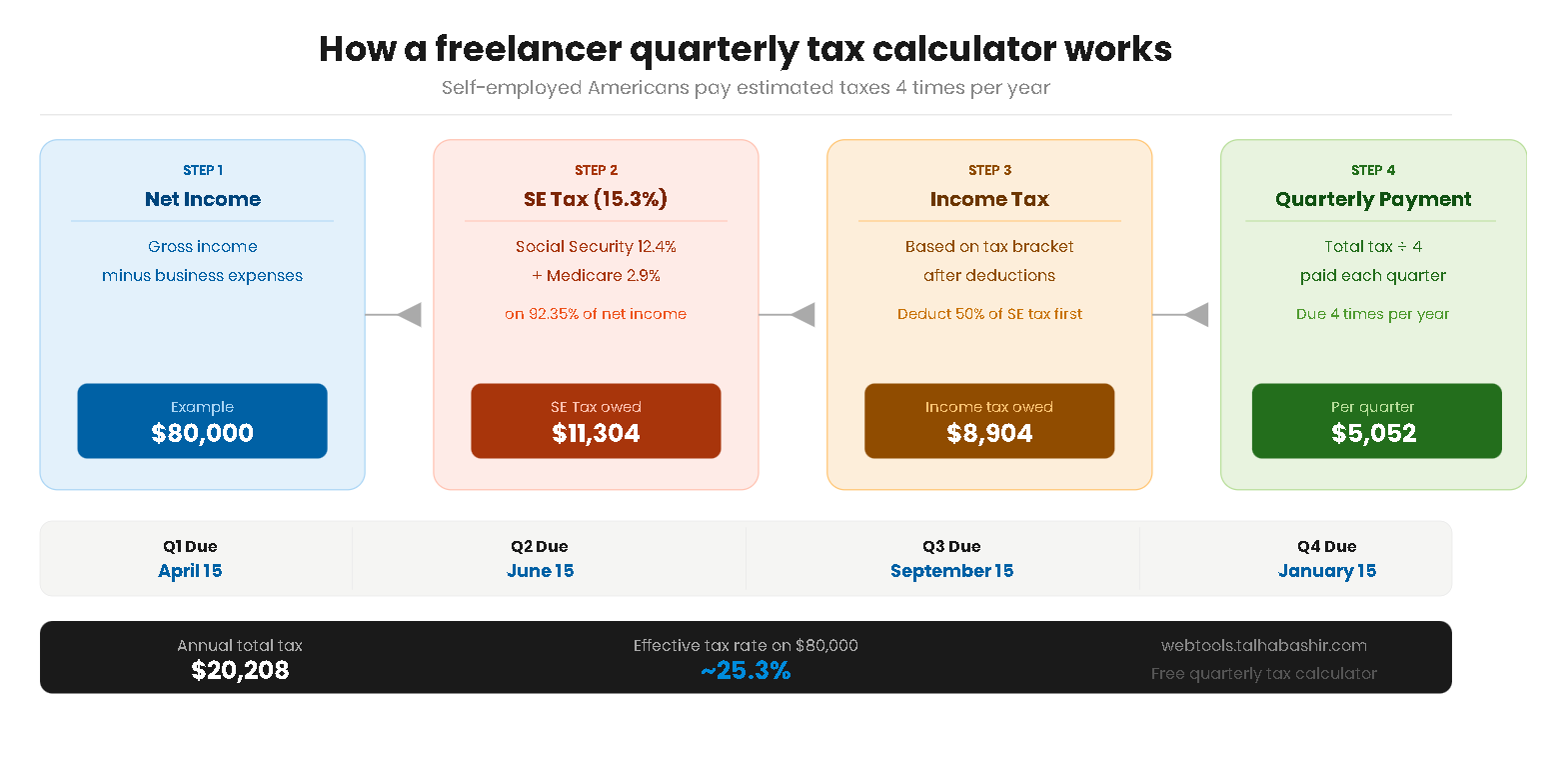
How to use this freelancer quarterly tax calculator 2026
Getting your 2026 quarterly tax estimate takes under a minute. Our freelancer quarterly tax calculator automatically handles self-employment tax, federal income tax, the QBI deduction, and your state income tax in one calculation.
Enter your annual gross income — the total you expect to earn freelancing in 2026.
Enter your business expenses — software, equipment, home office, and other deductible costs.
Select your filing status, state, and whether you qualify for the QBI deduction.
See your quarterly payment amount, full tax breakdown, and all four 2026 due dates.
What are quarterly estimated taxes for freelancers in 2026?
When you work as a freelancer or self-employed individual, no employer withholds taxes from your payments. As a result, the IRS requires you to pay estimated taxes yourself — four times per year. Quarterly estimated taxes cover two separate obligations: self-employment (SE) tax and federal income tax. Together these can add up to 25–40% of your net income depending on your earnings and state.
Our 2026 freelancer quarterly tax calculator now includes the QBI deduction (Qualified Business Income deduction) and state income tax — giving you the most complete picture of your real tax liability.
Who needs to pay quarterly taxes in 2026?
The IRS requires quarterly estimated tax payments if you expect to owe at least $1,000 in federal tax for the year after subtracting withholding and credits. This applies to freelancers, independent contractors, 1099 workers, gig economy workers (Uber, Fiverr, Upwork), and anyone with significant self-employment income.
2026 quarterly tax due dates
| Quarter | Income Period | Due Date |
|---|---|---|
| Q1 2026 | January 1 — March 31 | April 15, 2026 |
| Q2 2026 | April 1 — May 31 | June 16, 2026 |
| Q3 2026 | June 1 — August 31 | September 15, 2026 |
| Q4 2026 | September 1 — December 31 | January 15, 2027 |
How the freelancer quarterly tax calculator works for 2026
Step 1 — Self-employment tax (SE tax)
SE tax is calculated on 92.35% of your net self-employment income at the 15.3% rate. The 2026 Social Security wage base is $176,100 — income above this is only subject to the 2.9% Medicare portion. You can deduct 50% of your SE tax from gross income before calculating federal income tax.
Social Security cap: $176,100 (2026)
SE Tax Deduction = SE Tax × 50%
Step 2 — QBI deduction (20% deduction)
The Qualified Business Income (QBI) deduction allows most sole proprietors to deduct 20% of net business income from federal taxable income — reducing your federal income tax by up to 7–8 percentage points. For 2026, the QBI phase-out begins at $197,300 single / $394,600 married. Our calculator applies this automatically when enabled.
Phase-out starts: $197,300 (single) / $394,600 (MFJ)
Step 3 — Federal income tax (2026 brackets)
| Rate | Single filer | Married filing jointly |
|---|---|---|
| 10% | $0 — $11,925 | $0 — $23,850 |
| 12% | $11,926 — $48,475 | $23,851 — $96,950 |
| 22% | $48,476 — $103,350 | $96,951 — $206,700 |
| 24% | $103,351 — $197,300 | $206,701 — $394,600 |
| 32% | $197,301 — $250,525 | $394,601 — $501,050 |
| 35% | $250,526 — $626,350 | $501,051 — $751,600 |
| 37% | Over $626,350 | Over $751,600 |
Standard deduction for 2026: $15,000 (single) / $30,000 (married) / $22,500 (head of household)
Step 4 — State income tax
Nine states have no income tax: Texas, Florida, Washington, Nevada, Wyoming, South Dakota, Alaska, Tennessee, and New Hampshire. For all other states, our calculator applies your state's marginal rate to your net income after federal deductions. This gives you a more complete estimate of your total annual tax burden.
2026 safe harbor rule — pay at least 90% of this year's tax liability OR 100% of last year's tax liability (110% if your prior-year AGI exceeded $150,000) to avoid IRS underpayment penalties.
Tips to reduce your quarterly tax bill in 2026
Maximize your deductions
- Home office deduction — if you work from home exclusively, you can deduct a proportional share of rent, mortgage interest, utilities, and internet.
- Health insurance premiums — self-employed individuals can deduct 100% of health insurance premiums paid for themselves and their family.
- Retirement contributions — SEP-IRA contributions up to $70,000 (2026) and Solo 401(k) employee contributions up to $23,500 are fully deductible.
- Vehicle mileage — the 2026 IRS standard mileage rate is $0.70 per mile for business use.
- Software and subscriptions — any tool used for your freelance business is deductible — design software, project management tools, cloud storage, etc.
Use the QBI deduction
The 20% QBI deduction is one of the most valuable tax breaks available to freelancers and is often overlooked. If your taxable income is under $197,300 (single) or $394,600 (married), you almost certainly qualify. Our calculator applies this automatically — toggle it on to see the difference it makes to your quarterly payment.
Missing a 2026 quarterly deadline triggers an IRS underpayment penalty based on the current federal short-term interest rate plus 3%. Even an approximate payment on time is better than no payment — you can correct the amount the following quarter.
Official IRS resources for 2026:
IRS.gov — Estimated taxes for self-employed individuals IRS.gov — 2026 tax inflation adjustments